
Long Time, No Blog Update!
We had the best intentions when we started our blog, but… It’s been a while…
AI. It’s everywhere, it’s getting more and more powerful and we’ve got a few thoughts to share…
When we started Little Bird Creative back in 2020, AI was already in existence, albeit in an arguably less invasive way. If you’ve ever used an app like GoogleMaps to find your way around, or applied a spam filter to your emails, then it’s fair to say that you’ve been interacting with AI far longer than you might realise.
One of the benefits we hear about AI is that it saves time and takes away the boring jobs we don’t want to do. And sure, both of those things are arguably true! There are also many other great uses for the technology, such as cancer-screening and the development of tools that help disabled people to live more independently.
But let’s talk about AI in creative spaces…

Over the years, we’ve worked with some amazing clients, creating everything from websites, leaflets and event posters, to personalised Christmas cards and music videos. Each project has an enormous amount of care poured into it, not only because we want to do a good job for the people and organisations we work with, but because we’re aware of something pretty crucial: Every single one of those people and organisations is unique.
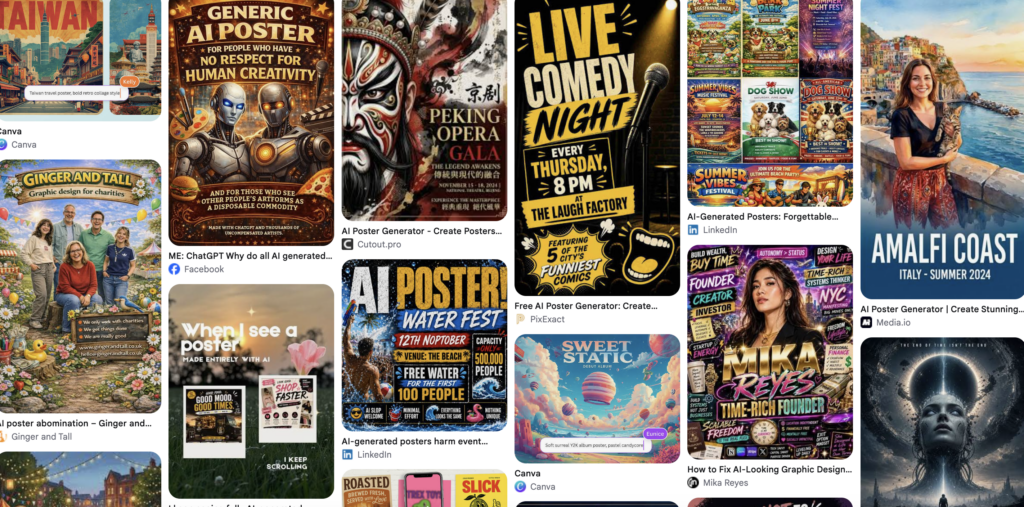
There’s a lot to be said about AI-generated posters or leaflets, but the word “unique” would not be the first that springs to mind. Unless you’ve been living in a cave for the last year or so, you’ve probably seen these cropping up all over the place…
Whether it’s the “busy” nature of these posters, the “uncanny valley” people featured in them, or the adherence to a very strict information hierarchy, AI posters have plenty in common. So much so, that at a glance, you would struggle to separate them into distinct brand identities. The poster may be promoting an event or advertising a place to visit, but the overall look is so strikingly similar, you’d have to look pretty closely to tell the difference.
We all know – or at least we used to know – the importance of brand identity.
When we work with a new client, we ask for their brand kit (and if they don’t have one, we help them create one). A brand kit features everything a designer or other creative professional needs to know about the organisation they’re working with, from what fonts they use, to the colours they prefer and the “voice” they speak with. It all adds up to a consistent image, that is instantly recognisable. For example, when you see the Coca Cola logo and their classic red and white colours, you immediately know what you’re looking at. However, AI doesn’t seem to have fully grasped that branding is what helps an organisation stand out from the crowd, so we instead end up with something of a homogenous mass…
Even if an organisation is happy to blend in with their competitors, using AI to generate graphic design can lead them to cut off some of their potential audience.
If you haven’t seen an AI poster “in the wild” yet, you’ve almost certainly scrolled past one on social media. Whilst you might not have thought twice about these graphics, there is a further problem with them: a distinct lack of thought regarding accessibility.
AI graphics often use their own fonts and these tend to be heavily stylised. This can make them hard to read with the naked eye, particularly for those with dyslexia or visual problems. Unless the person posting the image has included detailed ALT text, anyone using a screen reader is going to be left scratching their head, too. Not only this, but AI posters often lack the nuanced contrast levels that ensure all text is legible against a potentially busy or similarly coloured background. Colour-choices may be muddy or clashing, and the tendency of AI posters to fill every corner of space with either text or imagery can lead to them being simply overwhelming to look at, particularly for someone who is neurodiverse.
Of course, AI’s creative uses aren’t limited to posters or social media graphics. These days, more and more AI is creeping into music production and even film content. It’s very easy to look at those of us working in the creative sphere as simply feeling “threatened” by the rise of AI in these areas. It is, however, important to remember that generative AI doesn’t just burst into existence from nowhere. AI models scrape content from elsewhere in order to learn how to build something artificially “new.” The problem is, many AI models scrape copyrighted content, such as artwork, books and music, using these works as training materials. If you’ve ever heard an AI song and thought “oh, that sounds really familiar,” it’s probably because it is. Those of us working in creative industries know how much time and effort has gone into what we create, whether it’s a piece of writing, an illustration or a musical composition. The thought of it being scraped so that someone else can claim it as their own is, frankly, chilling.
AI also gives people a false impression of how “easy” it is to create something original. “what do you mean it’ll cost over a hundred pounds to design a logo? AI can do it in five minutes, why can’t you?!” I’d love to say that wasn’t a genuine comment, but…
We haven’t even touched on the environmental impact of AI yet, but most of us are aware of the staggering amount of water and energy used to run AI data centres – that’s a blog for another day, perhaps! Suffice to say, when we see companies who claim to have “sustainability” at the heart of what they do, churning out AI posters and social graphics, there is more than a slight raise of the eyebrow here at Little Bird HQ.
Look, we get it. AI is cheaper than using a professional graphic designer and times are undeniably tough for a lot of us right now. We also appreciate that AI saves a lot of time. As belts are tightened at organisations across the UK, the marketing budget is often slashed, leaving people whose jobs have never involved creating event posters or social posts, scrambling around, trying to put something together. But the trade off to saving money shouldn’t be the loss of your brand identity, or the creation of posters and graphics that freeze out members of your audience.
Obviously, we would love everyone to come to us for their creative needs, but we appreciate that cheaper options are out there. We recommend Canva.com, a free-to-use design website (with paid tiers available), where you can upload your own logo and images and use a library of fonts and graphics to quickly create everything from posters and leaflets, to email headers/footers and even animated social media posts. It’s simple to use and, when combined with your brand’s colours and logo etc, will help your organisation stand out against the sea of what has become (not-so-affectionately) known as “AI slop.”
So, what can we do to turn the tide, or is it too late?
We hope not. We believe that AI absolutely has a place in our ever-changing world, and we are probably only just scratching the surface of what it can do to save organisations time and money. But if your event poster sits on a wall next to thirteen others that look practically identical, we can’t see it doing anything to boost your brand identity.
As previously mentioned, AI also has a massive detrimental impact on our planet, which means many people have come to associate glaringly obvious AI content with an attitude of “so what?” when it comes to environmental concerns. You don’t have to be Greenpeace to realise that being seen as someone who doesn’t care about the future of the planet may not be great for business.
So, let’s roll up our sleeves and get creative. Let’s make sure our posters stand out from the herd. Let’s remember that the people we want to attract to our business or event are often looking for a more personal touch. If a large number of people are becoming more and more sceptical of AI, show them that you are the alternative! Let’s not let creativity die out, to be replaced by something soulless. Honestly, at this point, we’d be thrilled to see a poster created on MS Paint or using Word Art. It may be rough and ready, but it’s human and humans have been creating things for centuries. Let’s not stop now.
We had the best intentions when we started our blog, but… It’s been a while…
This month, we have some exciting news to share! We’re delighted to announce that, after having many people tell us how beautiful our designs are, we are opening an online shop! Whilst we put the finishing touches to the store, we’ve uploaded a few items to Etsy to give you an idea of the type of thing we’ll be selling, and we thought why not pick a few favourites to tell you all about – and explain a little more about what you can expect when you purchase from Little Bird Creative?
Event planning can be stressful – the last thing you need to add to your worries is promotion-related panic! Don’t fret. In this month’s blog, we’ve put together a guide to event promotion, to ensure everything goes off with a bang!
We use cookies to improve your experience on our site. By using our site, you consent to cookies.
Websites store cookies to enhance functionality and personalise your experience. You can manage your preferences, but blocking some cookies may impact site performance and services.
Essential cookies enable basic functions and are necessary for the proper function of the website.
These cookies are needed for adding comments on this website.
Statistics cookies collect information anonymously. This information helps us understand how visitors use our website.
Google Analytics is a powerful tool that tracks and analyzes website traffic for informed marketing decisions.
Service URL: policies.google.com (opens in a new window)
You can find more information in our Cookie Policy and .